Abaton Laboratory · Research
The Sheaf Experiments
What remains when an experience has passed?
After a hard month you return to ordinary life: same house, same work, same people.
Are you the same?
Most of us would say “mostly”, and then struggle to say where the difference sits.
Abaton Lab studies how observers hold together: how a person, a mind, or a group keeps a recognisable form while the world keeps pushing on it.
The theory behind the lab makes claims about this. Some can be investigated experimentally — not on people at first, but in small mathematical systems designed to explore the mechanisms involved.
Reading the Picture
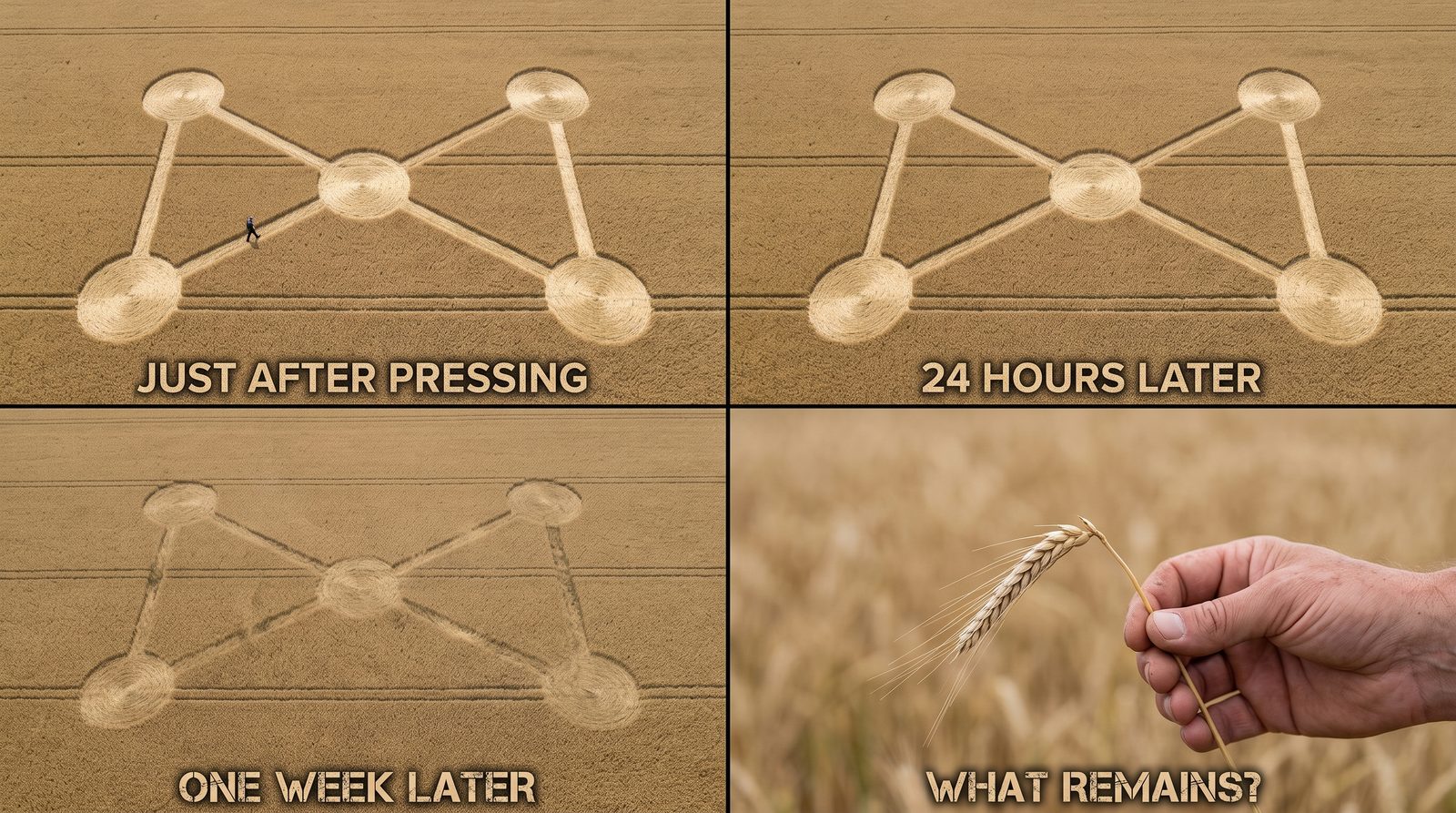
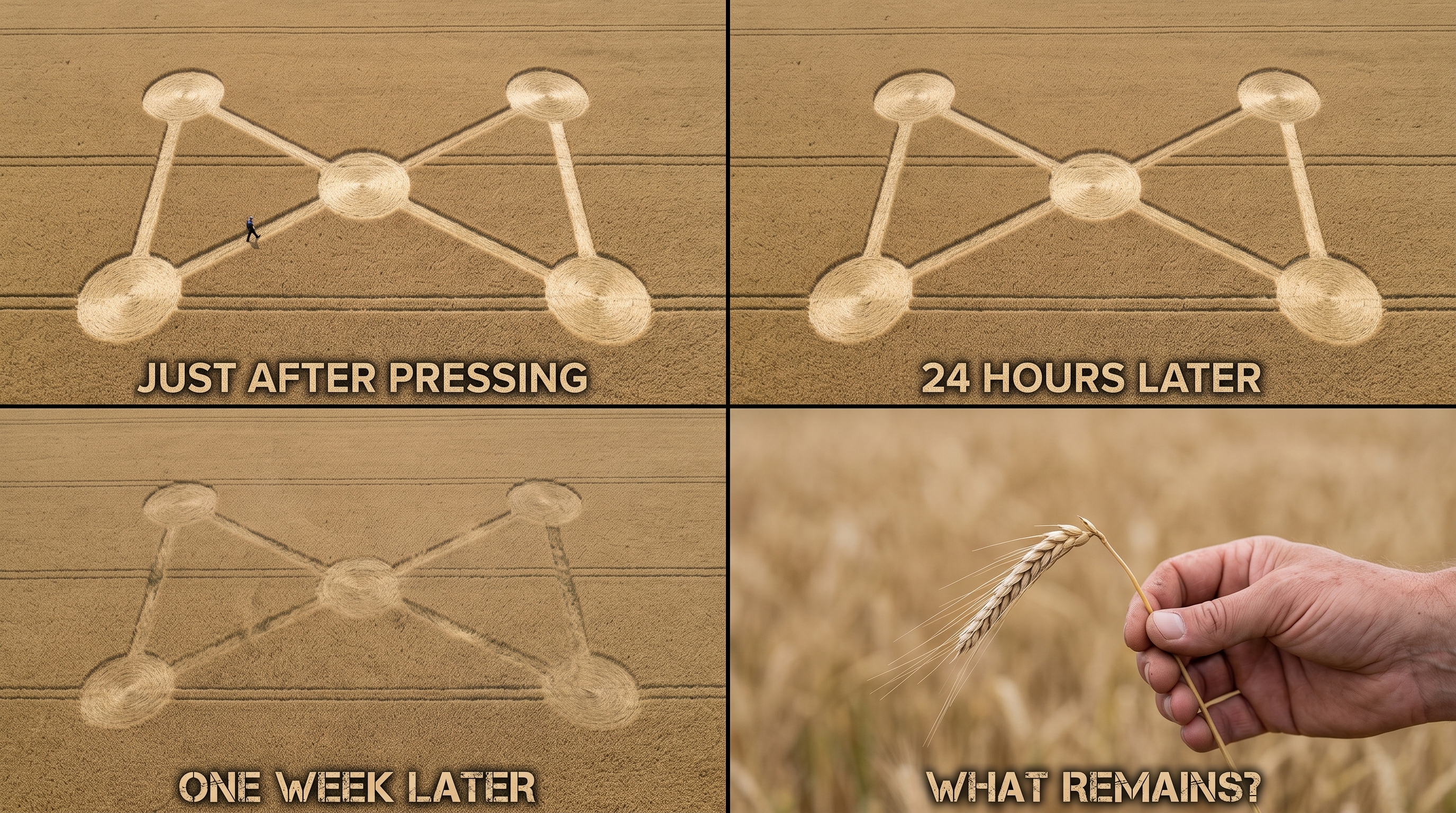
Look at the field.
- The circles are viewpoints.
- Each holds its own small piece of the picture.
- The paths are relationships.
- They are the ways viewpoints connect and must reconcile their different perspectives. The two triangles share one circle in the middle: what happens on one side can affect the other through it.
- The walker is an experience.
- Something passes through the system and leaves a mark on its relationships.
- The days after show recovery.
- The wheat rises again. The pattern fades. But how far does it fade? And how quickly, compared with how quickly the mark was made?
- The single stalk is the question itself.
- It stands upright again. Is it still the same stalk?
What We Actually Build
The wheat field is an illustration. In the laboratory, we model its underlying relational pattern mathematically.
The field. Five viewpoints, each holding two numbers: a small piece of the overall configuration. Six connections join them in two triangles sharing a central viewpoint.
Each connection has a pair of translation rules describing how the viewpoints express their local states in a shared language, allowing them to be compared.
Mathematicians call this kind of structure a sheaf. Coincidentally, a sheaf is also a bundle of stalks bound together.
At rest. Each field begins with an arrangement in which all viewpoints agree perfectly. This is our untouched wheat.
The pressure. We introduce a demand that cannot be fully satisfied by adjusting the viewpoints alone.
What remains unresolved is called residue: a measurable incompatibility between the imposed demand and the system’s current relational structure.
Two speeds. The system can respond in different ways.
Its internal state can adjust rapidly, rather like changing your posture.
Its relational translation rules can also change, more slowly and at a cost — somewhat like revising an established understanding.
We experiment with different costs of maintaining an internal configuration, departing from an established form, and reorganising relationships.
The Experiments
We investigate three deceptively simple questions.
01 The Excursion
What remains after the pressure disappears?
We change the demand and then bring it back to exactly where it started.
Do the relationships return to their earlier configuration? Or does something remain altered?
02 Two Routes
Does the journey matter?
Two different sequences of disturbance lead to the same final demand.
Afterwards, can we still tell which route the system travelled?
03 The Strain Alone
Can we infer a hidden change?
We give a decoder only the changing magnitude of the system’s unresolved incompatibility.
Can it detect whether the relationships beneath the surface have changed?
We repeat the experiments across independently generated fields, rather than relying on one particular configuration. The laboratory runs the simulations on its own computer.
What Can These Experiments Tell Us?
A mathematical sheaf is not a mind.
These experiments do not establish how human consciousness, memory, or identity operates.
Instead, they let us investigate particular mechanisms: how coherence is maintained, how incompatibilities arise, and how changing relationships may allow a system to adapt.
Some expected effects may appear. Others may disappear under closer examination.
Both outcomes matter.
Perhaps the most interesting question is not whether a system can return to its previous state, but whether it can remain recognisably itself after its relationships have changed.
What persists? What disappears? And what must change for coherence to survive?
These are the questions behind the Sheaf Experiments.